
Fairground
Make AI hiring worth trusting

Responsibility
Product Design Lead
Type
Self-directed exploration
Focus
AI product design
Year
2026
AI can rank thousands of candidates in seconds. But speed isn't the problem anymore.
Trust is.
Most hiring platforms return a score, a match percentage, or a ranking but they rarely explain how they got there. Recruiters are left with a decision they can't confidently defend, so they end up opening the CV and reviewing it themselves anyway.
The AI saves time.
Then immediately gives it back.
Fairground explores a simple question:
What if every AI hiring decision showed its work?
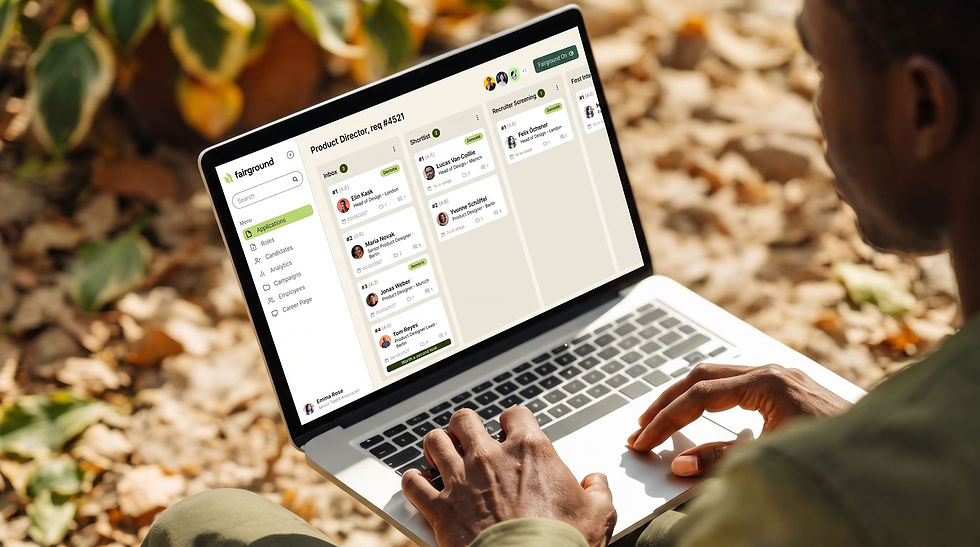
Why this matters
Imagine it's Monday morning and a recruiter opens their ATS to find 550 new applications waiting.
The AI has already done the first pass, ranking every candidate by how well they match the role. At the top of the list is someone with an 89% match score, followed by another candidate at 86%.
But what do those numbers actually mean?
Was one candidate ranked higher because they had more relevant experience, stronger technical skills, or because the AI inferred something from their CV that wasn't explicitly stated?
Without those answers, the recruiter has no choice but to open each profile, read through the resume, and verify the AI's decision themselves. The ranking becomes little more than a suggestion, and the time the AI was supposed to save is spent repeating the same manual work. The problem isn't that the AI made a recommendation, it's that it never showed its reasoning.
.jpg)

Fairground doesn't replace AI.
It helps people trust it.
Fairground sits on top of existing hiring platforms like Greenhouse, Ashby, Eightfold, and Teamtailor.
Instead of building another matching algorithm, it explains the one recruiters already use.
For every ranking it answers three simple questions:
-
Why was this candidate ranked here?
-
Which evidence came directly from the CV?
-
Which conclusions were inferred by AI?
Now every decision is easier to understand, review, and challenge.

The bigger idea
Most hiring platforms compete to build better AI. Fairground asks a different question.
What happens after the ranking appears?
Because the smartest AI in the world still becomes a black box if nobody understands its reasoning. Explainability isn't about making AI slower. It's about making people confident enough to use it.
Real research, not assumptions
A conversation with a recruiter using this exact category of tool reshaped two decisions directly:
Ranking needed to live at the list level, not just the detail level.
The expectation, in her own words: open an inbox of 200 overnight applications and immediately see the top candidates surfaced and sorted, not buried in a flat list with a small badge per row.
Trust, once earned, should be allowed to unlock automation. Her stated end goal wasn't just an explained ranking, it was trusting the AI enough to let it auto-schedule interviews with top candidates.
That became Fairground's future-state screen: automation that has to be earned through a visible track record, and that still shows its work even once it's acting on its own.

the workflow
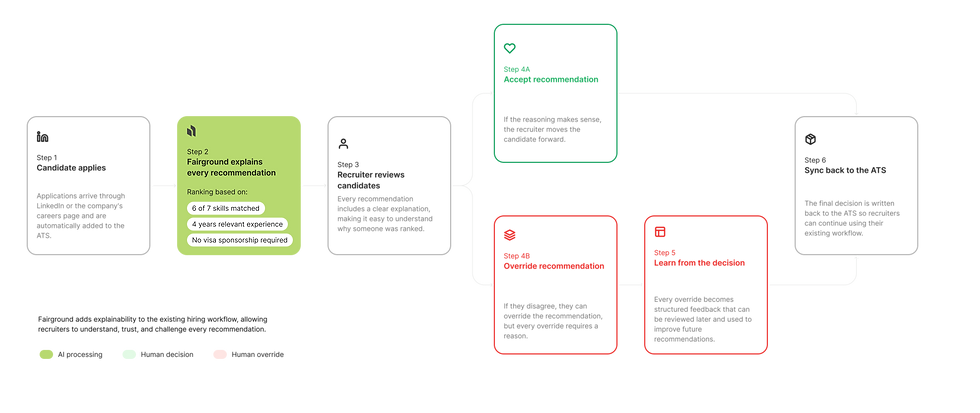

Trust isn't automatic.
Trust isn't something AI can assume—it has to be earned over time. Recruiters begin by reviewing every recommendation and deciding whether they agree with the reasoning behind it.
As confidence grows, the need to override recommendations naturally decreases, creating a measurable signal that the system is performing consistently. Only then does automation become appropriate, unlocking tasks like automatically scheduling interviews for top-ranked candidates. Even at that stage, every automated action remains transparent, reviewable, and open to challenge. The goal isn't to replace human judgment, but to build enough confidence that automation becomes a trusted extension of it.


What this project taught me
This project changed how I think about AI products. I began by exploring how to improve candidate ranking, but quickly realised the bigger opportunity was helping people understand and trust AI decisions. The strongest solution wasn't replacing existing hiring platforms—it was improving the moment where trust is won or lost.
It also reminded me that the best ideas don't always start as features. The fairness flag emerged as a natural result of making AI reasoning clearer, and one recruiter interview influenced several of the project's biggest design decisions.

SHARE App
More than Loyalty
